After a period of strong consumer demand for groceries, the Russian food market is now cooling down. Between January and September, the number of purchases in grocery stores increased by only 3.5% year-on-year, down from 6% earlier in the year. In September–October, sales of basic food items began to decline — a trend that is already weighing on retailers. Even discounters are seeing slower growth, and retail profitability may fall to a historic low, while tensions between retailers and suppliers continue to rise.
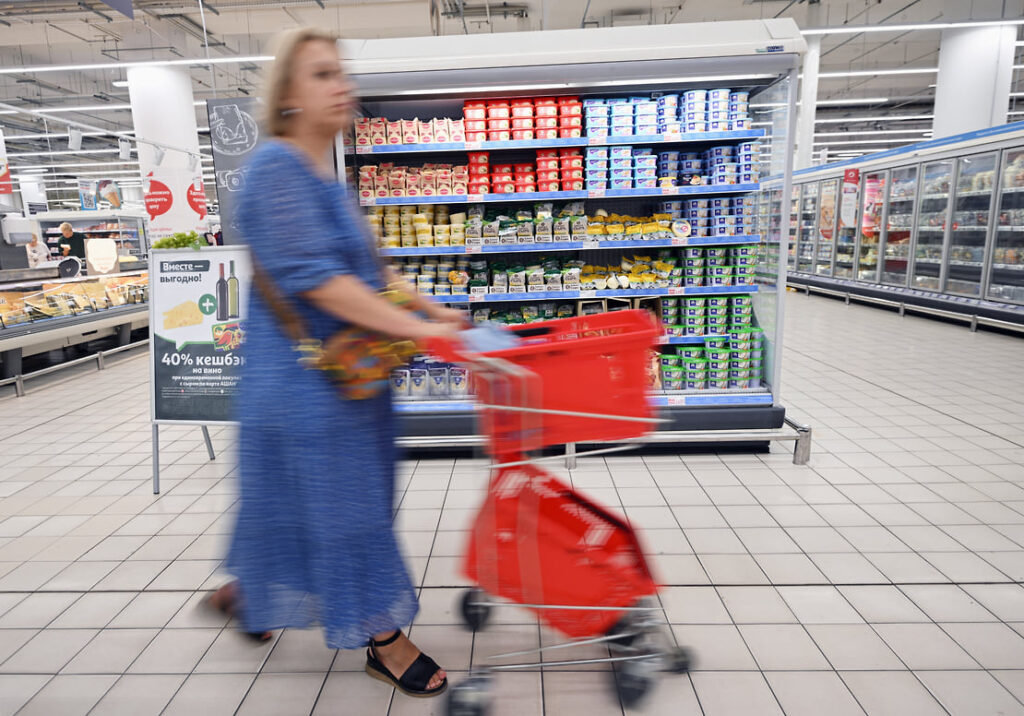
Photo: Evgeny Razumny / Kommersant
Consumer activity is weakening even in the everyday goods segment. According to data from Platform OFD’s Check Index, the number of customer transactions in grocery stores rose 3.5% year-on-year in January–September, compared with 6% in the first four months of the year. Evotor reports that in general food stores, the number of purchases remained flat compared to 2024, while in specialized stores it grew by just 1.5%. In butcher shops, the number of purchases fell by 7%.
Turnover in retail is growing mainly due to higher prices and larger average bills: the average grocery shopping trip cost consumers RUB 1,100, up 9% year-on-year.
According to Taxcom, sales of key food categories in September–October fell 5% year-on-year in physical volume. Milk sales declined by 8%, buckwheat by 9%, and rice by 10%. Data from T-Pay also shows a 2% drop in the number of purchases in supermarkets during January–September.
Experts warn that the downturn is likely to deepen and that the upcoming pre-holiday season will not offset it. The Gazprombank Center for Economic Forecasting expects total retail turnover in physical terms to grow just 1.8% in 2025, more than three times slower than last year’s 5.9%. Over the next few years, growth is projected at only 0.5–1% annually.
Consumers Tighten Their Budgets
According to Leonid Ardalionov, Director of Analytics at NTech, the slowdown in food sales began in December 2024 as consumers started trading variety for simplicity and affordability. “In 2023–2024, people had extra money and redirected it to food — eating well became a small pleasure, while expensive cars and watches remained out of reach,” he says.
The delicacies category — cheese assortments, caviar, seafood, lightly salted fish, rolls, cured meats, and similar products — illustrates the trend. In 2023–2024, growth in this segment outpaced the market by 3.7 times, but in January–May 2025, sales volumes fell one-third below average.
Consumers are not eating less, Ardalionov notes, but spending more rationally: avoiding excess purchases, seeking discounts, and choosing cheaper options.
Cherkizovo Group adds that in crises, consumer sentiment worsens gradually: first, shoppers seek discounts and cheaper channels, then switch to lower-cost product categories, and only later begin to forgo some products entirely. The company believes that consumers are still in the first stage of rationalization.
Retailers See Slower Revenue Growth
The slowdown in food demand is already reflected in retailers’ performance. According to Infoline, the top 10 FMCG chains reported combined revenue of RUB 6.1 trillion in H1 2025, up 17.1% year-on-year, versus 24.7% growth in H1 2024.
X5 Group’s Q3 revenue reached RUB 1.16 trillion, up 18.5% year-on-year, compared to 21.6% in Q2. For its fastest-growing banner, Chizhik, Q3 2025 was the first reporting period since 2021 with no sequential revenue increase, according to Alfa-Bank analysts. Metro Russia saw its Q3 sales rise by 4.9%, compared with 6% in Q2 and 13% in Q3 2024.
X5 confirms that overall growth in food retail is slowing, with consumers trading down to cheaper segments. Stanislav Bogdanov, Chairman of the Presidium of the Retail Companies Association, also sees a slowdown but doubts there will be a full-scale decline in demand for essential goods. He notes, however, that retailers’ profitability is under pressure from rising labor and logistics costs.
According to Emil Safarov, analyst at PSK-Solutions, financial results of major retail players are likely to “reach a plateau” — growth will slow but not reverse. Infoline estimates that average net profit margins for the top FMCG chains could fall from 2.3% in 2024 to 1.7–1.9% in 2025, the lowest in history. Partner at One Story, Olga Sumishevskaya, agrees that profitability is declining across the sector.
Alexander Zaitsev, CEO of Atomic Capital, warns that price wars may worsen the situation: “Competition for customers forces retailers to hold prices even as costs rise.”
Government controls on food prices further exacerbate the issue, says Artur Gafarov, Head of the Institute for Business Development and Economics. Retailers cannot pass higher costs to consumers, distorting business models and triggering disputes with suppliers — who themselves face the need to raise prices.
Retailers are demanding compensation for lost margins through supplier discounts and marketing fees, notes Dmitry Leonov, Deputy Chairman of the Rusprodsoyuz food industry association. This, he says, adds further strain to the supply chain.
Searching for New Formats
According to Andrey Sharov, analyst at BCS World of Investments, retail profitability could recover in 2026 thanks to improved operational efficiency, slower cost growth, and lower lending rates.
Retailers can already optimize their models, says Kirill Malyshev, by anticipating changing consumer behavior — for example, expanding private label (PL) products in price-sensitive categories. Emil Safarov notes that PL products now account for over 12% of total retail revenue, and the share continues to grow. Private labels allow tighter cost control and reduced marketing expenses. Another focus area is ready-to-eat meals, which combine strong margins with price control.
However, Zaitsev cautions that betting solely on high-margin segments is not sustainable: “The market is saturated, and competition in ready-to-eat food is increasing.”
He believes the key lies in boosting operational efficiency — warehouse automation, loyalty programs, and waste reduction — while also exploring new growth areas. Yet modernization and expansion require investment, which many retailers hesitate to make given high borrowing costs.
Retailers are also optimizing store formats. According to Infoline, the number of supermarkets and hypermarkets in January–September fell 1.4% year-on-year, with 67 large stores (totaling 185,000 sq. m) closing. The market continues to shift toward discounters and convenience stores.
Nikita Kornienko, CEO of SimpleEstate, says retailers now prefer premises under 700 sq. m, compared to traditional supermarkets starting at 1,000 sq. m: “Smaller stores have better unit economics — they focus on high-margin products and require fewer staff.”
Producers Rethink Their Strategies
The slowdown in food demand poses a serious challenge for manufacturers as well, says Dmitry Leonov, Deputy Chairman of the Rusprodsoyuz food producers’ association. According to him, companies are now revising their development plans and seeking ways to stimulate sales by optimizing product portfolios or promoting new offerings.
Analysts at Freedom Finance Global note that in January–September, Russia’s food production fell by 0.6%, while beverage output dropped 4.1%. They attribute this to high borrowing costs and depressed domestic prices for certain product categories.
Alla Andreyeva, CEO of the Union of Juice, Water and Beverage Producers (Soyuznapitki), says market participants are approaching 2026 with caution. Non-alcoholic beverages are not considered essential goods, so demand for them can easily decline. The industry, she adds, is counting on balanced policies from retailers and support from the authorities.
Manufacturers continue to rely on measures unpopular with consumers to maintain profitability — such as reducing package sizes while keeping prices unchanged, a practice known as shrinkflation. Leonid Ardalionov notes that in Q2 2025, the average package weight of food products fell by 3%, compared with 1% during the market’s peak growth in Q3 2024. Artur Gafarov adds that producers are now forced to adjust both the quality and quantity characteristics of their products to remain sustainable.
Alexandra Mertsalova, Alina Migacheva, Vladimir Komarov
Kommersant, October 30, 2025
This article has been translated to English by PSK‑Solutions LLC. The original version in Russian is available here.
This is an unofficial translation provided for informational purposes only. All rights to the original content belong to the original author(s), and no copyright infringement is intended. While we strive for accuracy, slight discrepancies may occur in the translated version.